What Should We Notice When We Open a Beauty Store
Nature and Light Luxury
The design of the beauty store has long transcended its role as a mere sales space. It becomes the first point of contact for brands to engage with consumers. The fusion of nature and light luxury is the core secret that attracts customers to this beauty store—natural elements echo the product concept of natural skin care, dispelling the coldness of commercial spaces. Light luxury materials, on the other hand, anchor the high-end positioning, matching the refined nature of beauty consumption. The tension created by the collision of the two makes the space both soothing and sophisticated.
Contemporary consumers not only long for a sense of relaxation when shopping but also need to confirm the professionalism of a brand through the texture of the space. The interweaving of natural green plants and metallic lines, as well as the echo between matte paint surfaces and marble textures, essentially conveys the brand’s values through spatial language. When customers step into the store, the perception of “natural × refined” is quietly established.

Space creation
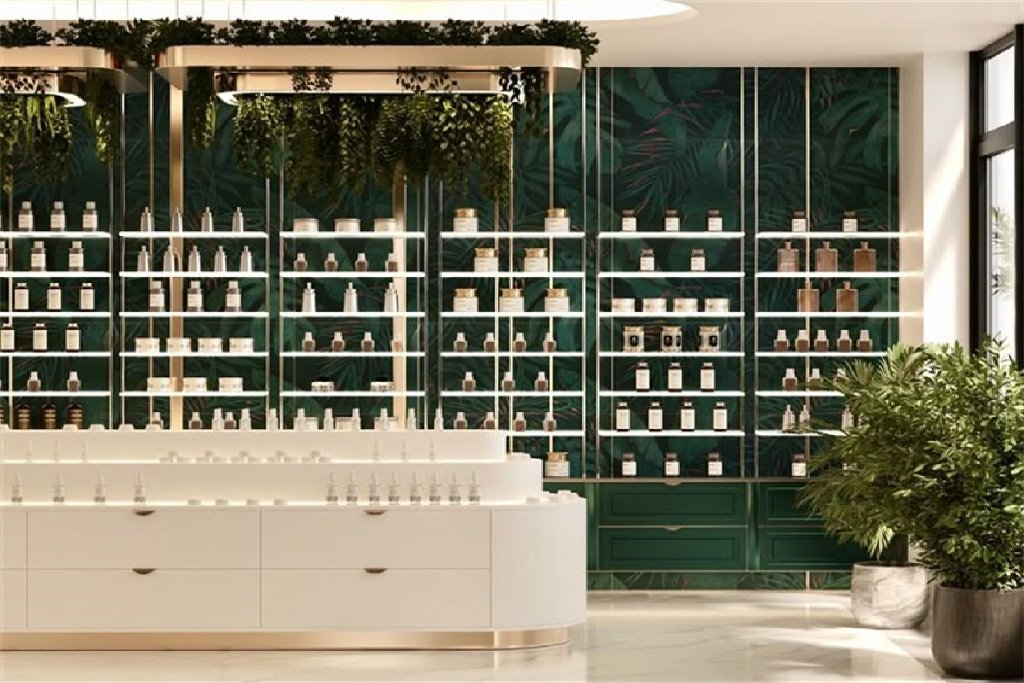
Every layout in the space tells a “silent story,” guiding the consumer’s movement. The vertical green plants are embedded in the off-white marble background wall, and the golden metal letters “MiSo beauty shop” become the visual focus. The front desk uses matte green lacquered panels and a white marble countertop with a golden line in the middle, forming a color order of “green-white-gold” with the background wall—it not only soothes the mood with a natural atmosphere but also enhances the sense of luxury with the metallic luster.
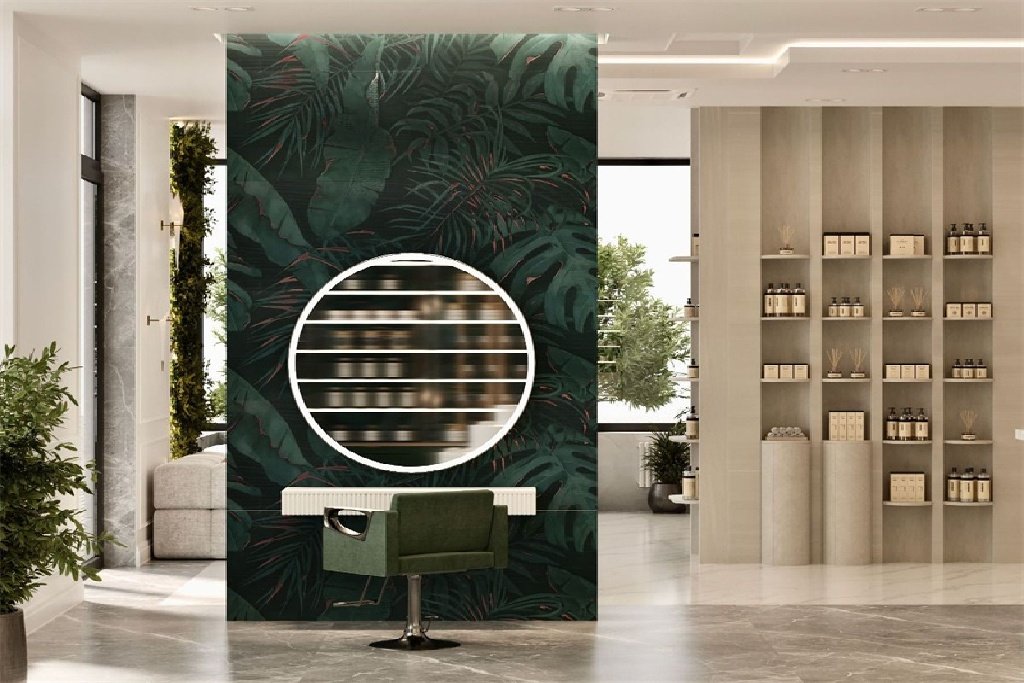
Entering the store, the service experience area is designed with a tropical plant wall fabric to create a rainforest boundary. An oval-shaped metal mirror paired with a circular LED light and dark green leather seats complements the overall color scheme. This design is full of ingenuity, as the plant wall fabric blurs the spatial boundaries. The circular light accurately reflects the makeup effect. It turns the makeup trial process into an “immersive experience” rather than a simple consumption behavior. The product display area is divided into display and experience functions. Open shelves with brass frames are suitable for customers to explore independently. Embedded display cabinets highlight high-end items with bottom lighting. The background wall continues the tropical plant pattern, making the products more dynamic in a “natural context.”
Philosophy of Materials
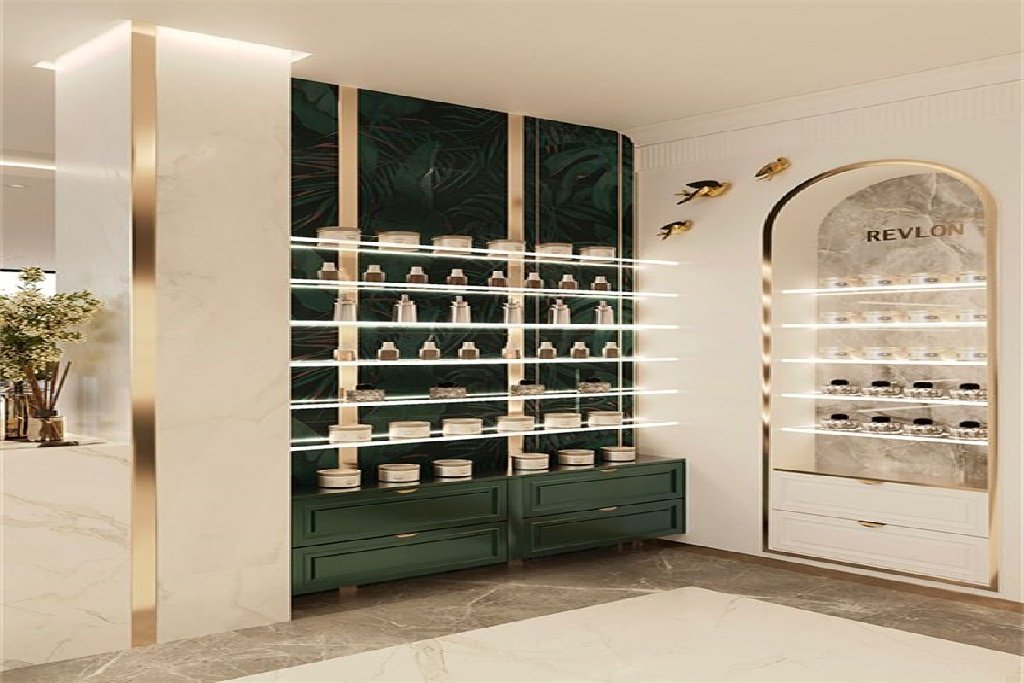
The material selection in a beauty store is a compromise art between “good looks” and “good usability.” Each material is imbued with design ingenuity. Marble, as the “textural base” of the space, is used for the floor, the front desk, and the display backboard. The light gray/milky white texture naturally exudes a sense of luxury while being wear-resistant and easy to clean. It is suitable for high-traffic areas. The natural texture is retained during cutting, deeply resonating with the brand’s philosophy of “naturalness.” Metal is used in the form of fine lines to outline the brand name, mirror frames, and display rack contours. To avoid excessive use, it is only used as a “refined accent,” making the light luxury feel more restrained and sophisticated.
The dark green matte lacquer board of the green series material is used for the front desk and drawers, and the tropical plant wall fabric creates a visual impact. The two together build a “natural color system,” yet they also meet the cleanliness requirements of a beauty store. The layered lighting design not only illuminates the products but also creates an atmosphere; the artificial green plants form a “three-dimensional system,” achieving the infiltration of a natural atmosphere at zero maintenance cost, keeping the space always having a “breathing sense.”
Business Logic
The design of a beauty store ultimately serves the dual goals of experience and sales. From the perspective of experience, a natural atmosphere reduces customers’ defensive mentality, while a light luxury feel enhances brand trust. The combination of the two makes the decision-making process from trying on makeup to purchasing smoother. The simulation of natural light in the makeup trying area and the self-exploration design in the display area both extend customers’ stay time. And the comfortable spatial atmosphere itself is a form of “covert marketing.”
From the operational perspective, wear-resistant materials, storage design, and lighting compatibility significantly reduce the cost of later maintenance. More crucially, there is a brand premium. The process by which customers transition from “browsing the store” to “identifying with the brand” is precisely the key to the design-driven consumption loop.