How to renovate a barbershop into a jewelry boutique?
The encounter of history and jewelry
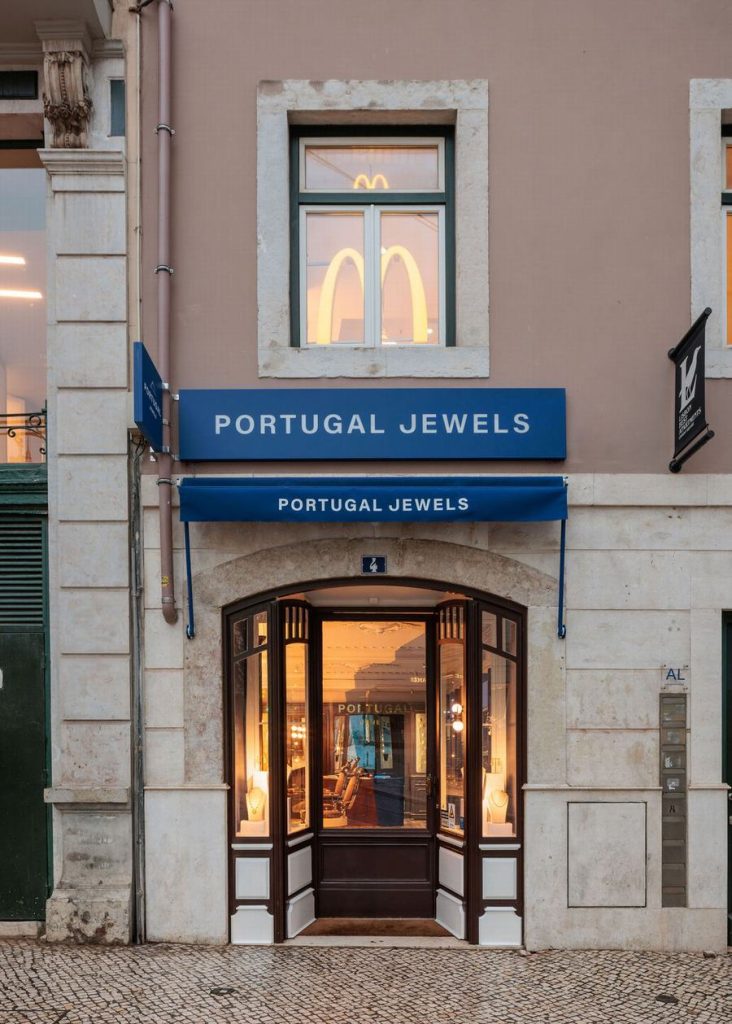
In Lisbon’s Piazza Ciado, a 40-square-meter space in an 18th-century Pombal-style building is undergoing a transformation that spans a century. This place was once the home ground of the legendary Barbearia Campos barber shop. Since the end of the 19th century, the images of cultural celebrities such as Fernando Pessoa have been sculpted here. The sound of hair clipping and the collision of literary trends have filled the space with the weight of art and social heritage.
When the hustle and bustle of haircuts subsides, history has not yet come to an end. The design team, with the core concept of “respecting history rather than covering it up,” has transformed it into a jewelry boutique dedicated to the traditional Portuguese gold and silver filigree craftsmanship. This renovation is not a severing of the past but a dialogue spanning three centuries—the architectural texture of the 18th century, the commercial memory of the 19th century, and the design language of the 21st century, all interwoven and coexisting here.
The philosophy of restrained transformation
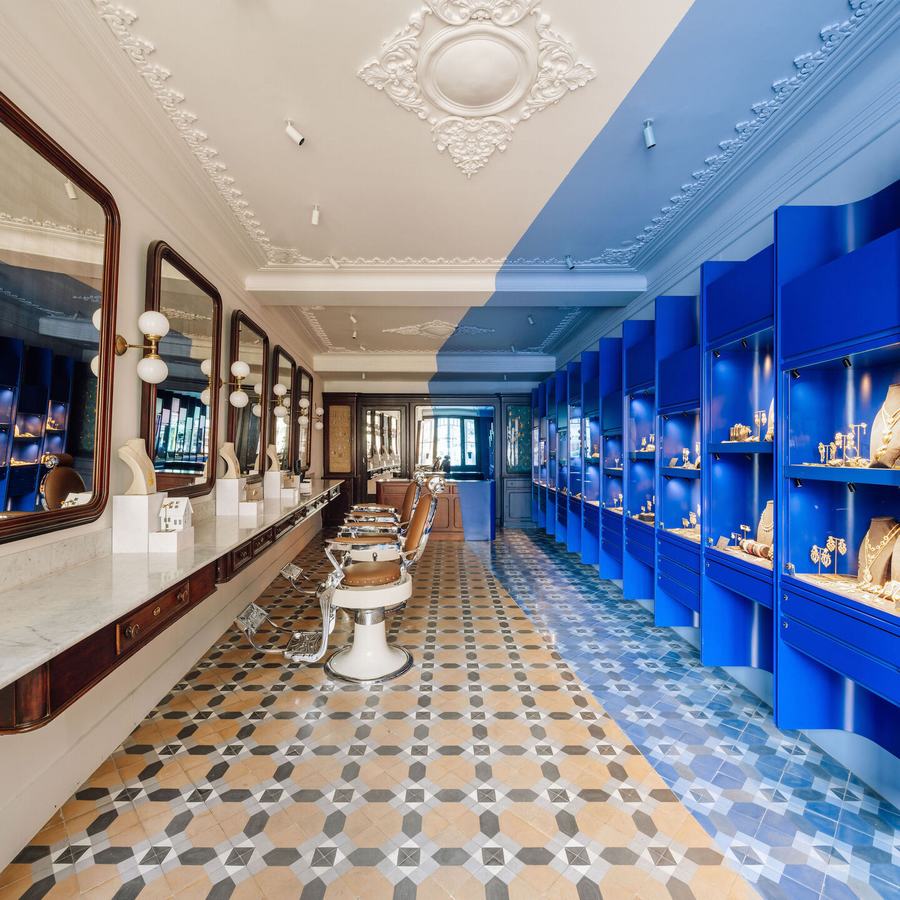
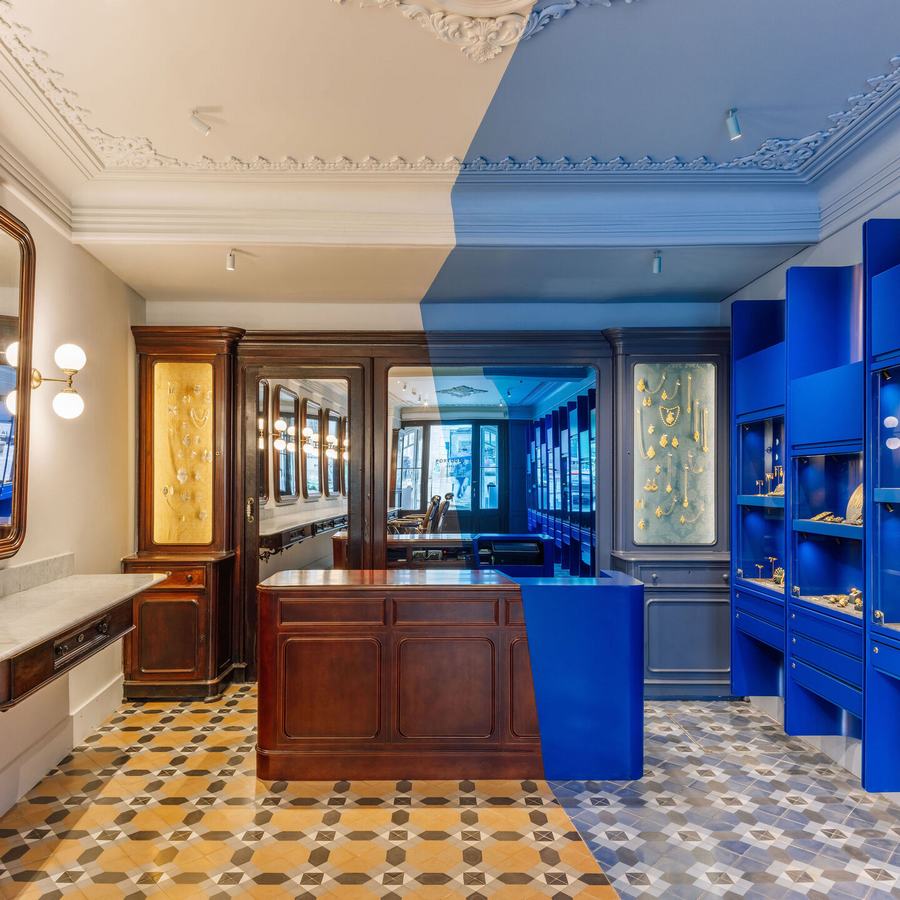
The first step of the transformation is to resolutely abandon the concept of “thorough renovation.” The design team chose to adopt a “simple and reserved” approach to preserve the historical genes of the space: the carved ceilings of the Pombal-style architecture, the solid wood counters of the barber shop, and the marble operation countertops were all completely preserved and meticulously restored. Every wood grain and every carving is a mark of time, telling the century-old story of Ciado Square.
This “preserving transformation” makes history the background color of the space. When customers step into the store, they are first enveloped by the retro atmosphere of a 19th-century barber shop: the stability of dark solid wood, the coldness of marble, and the metallic luster of the vintage barber chairs instantly transporting them back to that era brimming with celebrities. And this profound sense of history precisely becomes the most narrative stage for the display of modern jewelry.
The visual magic of Klein blue
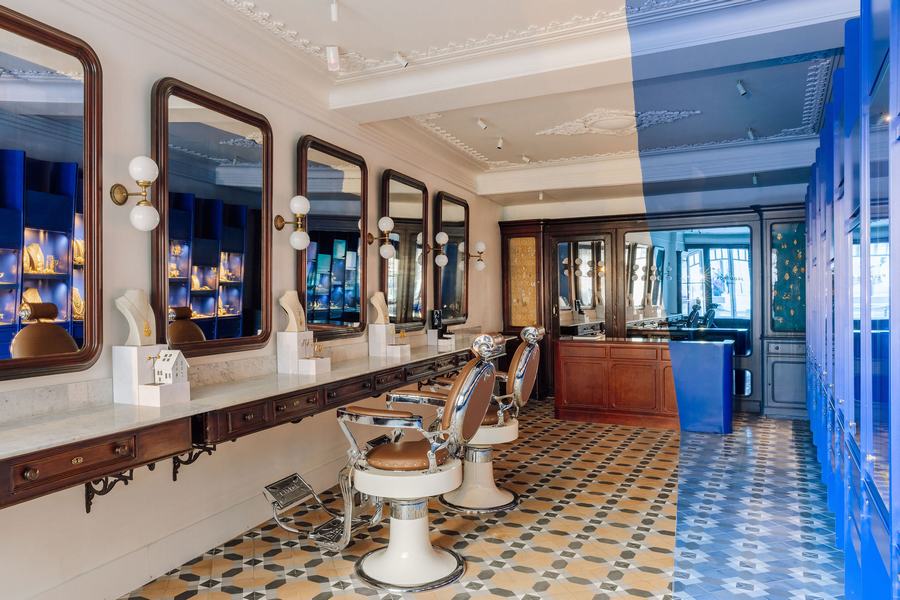
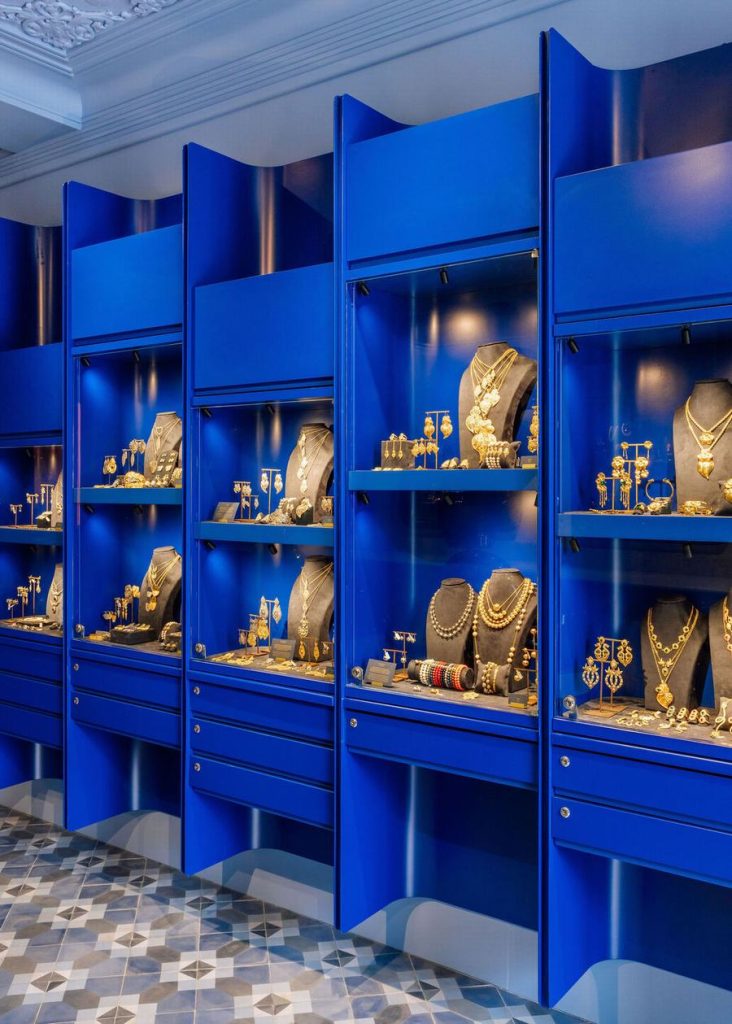
The visual focus of the renovation lies on the right wall inside the room. The custom-made jewelry display cabinets and service counters are marked with “Klein Blue,” using the simple lines of modern design to break the dullness of history. The collision of avant-garde materials and pure blue also makes this area the “visual anchor point” of the space, creating a strong temporal and spatial tension with the simple hairdressing mirror area on the left.
But this shade of blue was not an abrupt intruder. It is like a soft filter, slowly seeping into the texture of the space: the painted ceiling spreads out a blue gradient, the woodworking details are given a blue tone, and even the self-adhesive film on the mirror hides a blue mystery. The renovation of the floor is even more ingenious—some of the original painted tiles have been replaced with the same blue style from the same manufacturer, allowing the new and old tiles to complete a dialogue of colors through the echo of patterns, achieving the renovation philosophy of “seamless integration.”
The Rebirth of Heritage
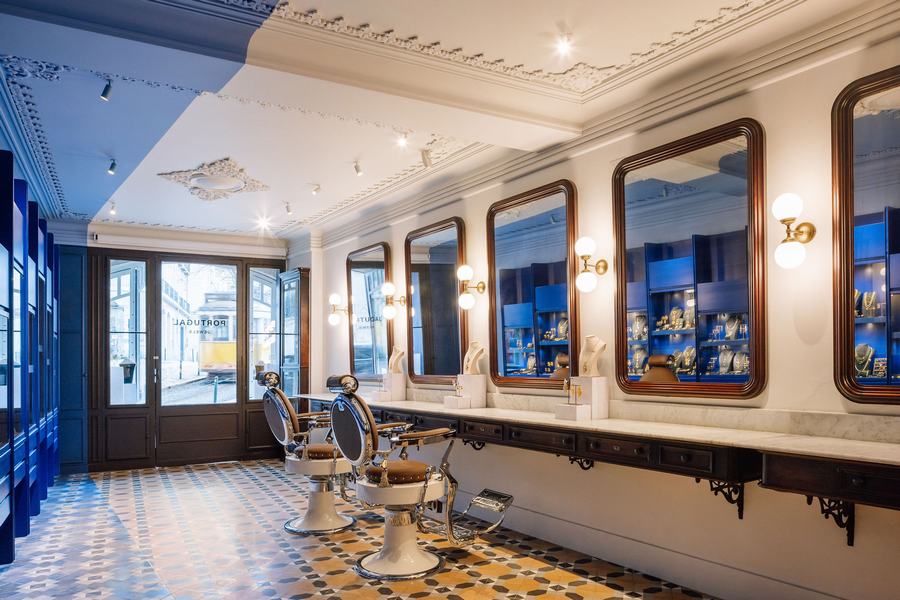
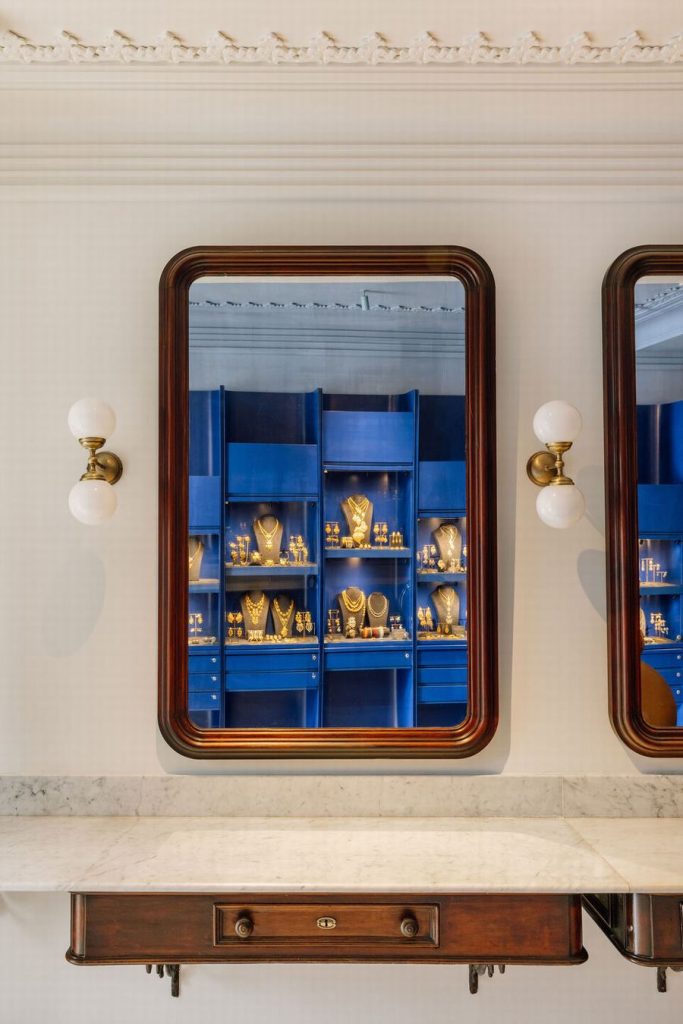
The soul of Barbearia Campos has never left. The six hairdressing mirrors are still neatly arranged, but the changes in hairstyles are no longer reflected in them; instead, the brilliant luster of Portuguese gold and silver jewelry is displayed. The original hairdressing stool has been given a new identity as a “try-on throne.” Customers sit on the stool and try on jewelry in the mirror image of history and modernity, completing an aesthetic ritual that transcends time and space.
The preservation of two vintage hairdressing chairs is the finishing touch. They are no longer tools for haircuts but “ritual carriers of self-expression”—when customers sit on the chair, under the dual reflection of the hairdressing mirror and jewelry, they are both choosing accessories and participating in a “ritual of shaping personal style,” allowing the beauty tradition of the 19th century to blend perfectly with contemporary self-expression.
The symbiosis of craftsmanship and memory
The jewelry in this store is a material epic of Portuguese craftsmanship. The fine craftsmanship of gold and silver wires has come alive in modern design. Each piece of jewelry is like a miniature work of art, resonating spiritually with the historical heritage of the space—they are all concrete expressions of Portuguese culture, one carrying the inheritance of craftsmanship and the other recording the memory of society.
When a customer tries on a gold and silver fine-workmanship wire necklace in front of a vintage hairdressing mirror, the spatial outline of the 19th century and the self-image of the 21st century are reflected in the mirror, and in their hand is the crystallization of traditional Portuguese craftsmanship. This multi-dimensional experience enables shopping to go beyond mere consumption behavior and also become a profound dialogue among history, craftsmanship, and personal style.
The transformation from Barbearia Campos to a Portuguese jewelry boutique provides a benchmark model for the renovation of historical spaces. It proves that the renovation of historical buildings does not have to be an either-or proposition; history and modernity can become a symbiotic organism through ingenious design.