How to Decorate A T-Shirt Kiosk in the USA?
In the dynamic landscape of American retail, the T-Shirt kiosk stands as a unique and potent business model. Unlike a static storefront, a kiosk operates within a high-traffic, competitive environment like a shopping mall, airport, or festival grounds. Here, your physical space is not just a point of sale; it is your primary marketing tool, your brand ambassador, and your first—and often only—chance to capture a customer’s attention. Decorating your kiosk effectively is not a matter of mere aesthetics; it is a critical business strategy that directly influences foot traffic, conversion rates, and overall profitability.
Laying the Foundation
Before you select a single prop or paint color, you must have an absolute clarity on your brand identity. Your kiosk’s decoration is the physical manifestation of your brand. Are you a quirky, humor-driven outlet selling pop-culture parody tees? A premium, artisan brand focusing on organic materials and minimalist designs? Or perhaps a sports-centric hub for local team pride? Your theme dictates every subsequent decision. A clear identity ensures your décor choices are cohesive and tell a consistent story, making your kiosk memorable rather than confusing.
Colors evoke powerful psychological responses. A kiosk selling vibrant, beach-themed shirts might opt for a scheme of aqua blue, sunny yellow, and sandy beige. A brand focused on vintage, retro designs might use weathered wood, classic black, and muted burgundy. Select two or three primary colors to reflect your brand’s personality. Use them consistently across your signage, shelving, and displays. This creates a professional, polished look that customers subconsciously trust.
Theme informs material choices. A rustic, Americana brand would benefit from authentic materials like reclaimed wood, corrugated metal, and rope lighting. A modern, tech-oriented custom print kiosk might use sleek acrylics and LED light strips. The goal is to create a multi-sensory experience where the materials themselves reinforce the quality and style of the T-Shirts you are selling. Building credibility before a customer even touches a garment.
Mastering the Structure
The physical layout of your kiosk is a puzzle of efficiency and appeal. The primary goal is to create an intuitive and inviting flow. Draws customers in and allows them to browse comfortably without creating bottlenecks. The perimeter of your kiosk is your most valuable real estate. Where you will display your best-selling and most eye-catching designs at eye level to stop passersby in their tracks.
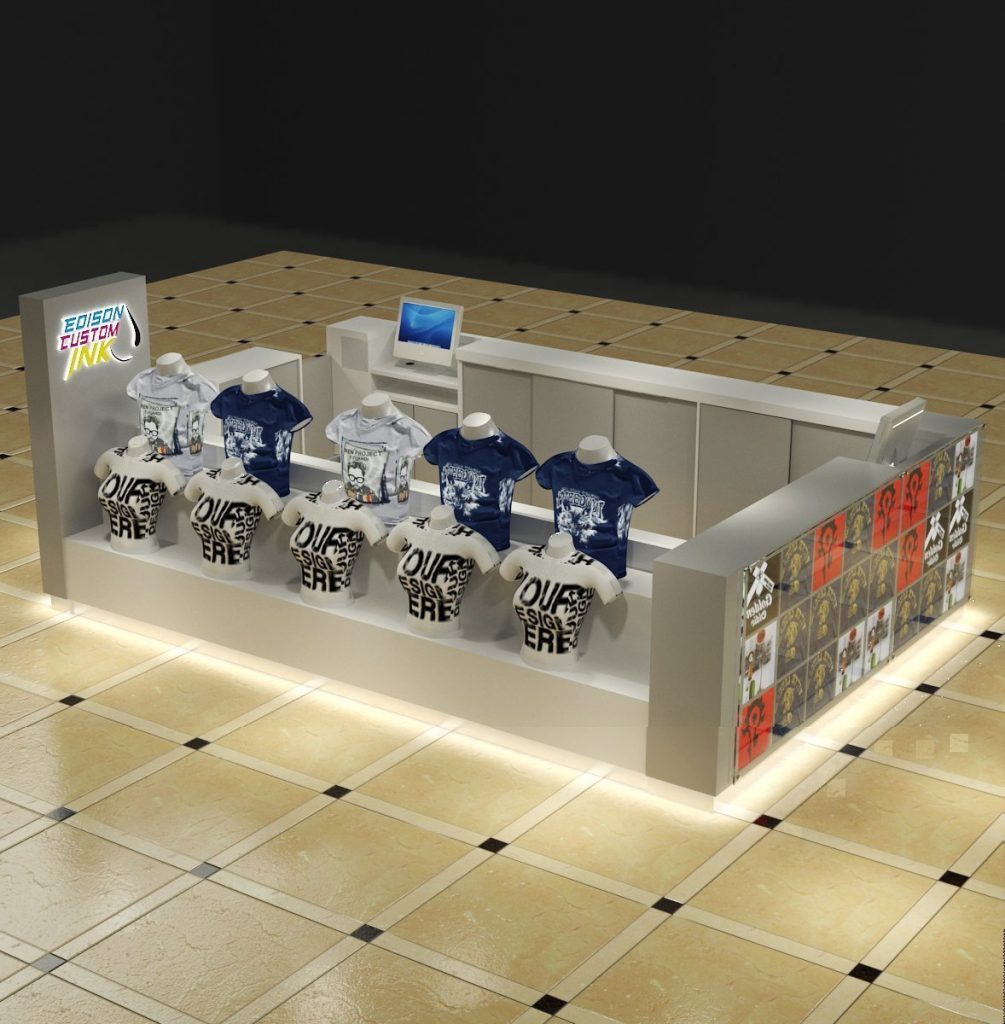
Within the kiosk avoid overcrowding. While it’s tempting to display every design you have, a cluttered space cheapens your product. Use tiered shelving and multi-level display arms to create vertical interest. It maximizes your display capacity and makes your merchandise visible from multiple angles across the mall concourse. Ensure there are clear pathways for customers to enter and exit. Cash wrap station is positioned to not obstruct traffic while allowing your staff a clear view of the entire operation. View clothing shop display
Consider a “feature” element. This could be a central, four-sided display cube or a mannequin positioned strategically. This feature acts as a focal point, breaking up the visual plane and creating a sense of depth. For kiosks offering customization, the printing machine itself can be a part of the décor. Framing it neatly with branding and using clear, organized bins for blanks and vinyl can turn a functional piece of equipment into a compelling display. Demonstrates your capabilities and attracts customers interested in personalized products.
Power of Visual Merchandising
How you present your T-Shirts is just as important as the designs themselves. The golden rule is to maximize graphics visibility. This means heavily favoring displayed, hung shirts over folded ones. Use sturdy, uniform hangers and display arms that allow shirts to be faced forward. Ensuring the graphic is immediately visible from a distance.
Incorporate a variety of display methods to create visual texture. Mannequins or torso forms are incredibly effective as they allow customers to see how the shirt fits and looks on a body. Mix in framed artwork or large, high-quality prints of your most popular designs on the back wall of the kiosk. This technique, known as “wall storytelling,” sells the lifestyle associated with your brand and helps customers visualize the shirt beyond the rack.
Lighting is the secret weapon of effective visual merchandising. Use spotlights to illuminate your featured displays and mannequins, making them pop against the background. Ensure every graphic on every hung shirt is well-lit and vibrant. Proper lighting creates a premium feel, highlights the quality of your prints. Makes your entire kiosk a beacon of brightness in a often dim mall environment.
Strategic Signage and Clear Communication
The most critical sign is your primary branding—your kiosk’s name and logo. It should be large, well-lit, and visible from at least two opposing approaches. Customers should know who you are and what you sell within three seconds of glancing your way. Check display rack style
Beyond your name, use signage to answer common questions and overcome objections. Do you offer custom printing? A prominent “Custom T-Shirts While You Wait” sign attracts that specific customer. Have a compelling price point or promotion? “2 T-Shirts for $30” is a powerful draw. Use arrows or pointing hands to guide the eye toward these offers. Testimonials or a “As Seen On” logo (if applicable) build social proof and credibility. Every sign should have a purpose, whether it’s to inform, persuade, or direct.
All text must be concise and scannable. Use bold, high-contrast colors (e.g., black text on a yellow background) for maximum readability from a distance. The language should be active and benefit-oriented: “Find Your Style” is more engaging than “T-Shirts Sold Here.” For any custom order process, use simple, numbered steps with icons (1. Choose Shirt, 2. Pick Design, 3. We Print) to demystify the process and make it feel easy and accessible to hesitant customers.
Engaging and Interactive Elements
To truly differentiate your kiosk, move beyond passive displays and create an interactive experience. Engagement dramatically increases dwell time—the length of time a customer spends at your kiosk. The longer they stay, the more likely they are to make a purchase. For customization kiosks, this is inherent; customers are engaged in the creative process. But even for pre-designed shirts, you can create interaction.
Technology is a powerful tool. Mount a tablet or a small screen displaying a slideshow of your designs, customer photos wearing your shirts, or even a live feed of your printing press in action. This adds movement and energy to your space. Consider implementing a digital lookbook where customers can browse your full catalog without you having to physically hold up every design, which is especially useful during peak busy times.
Simple, tactile interactions are also highly effective. Have a “feel” station showcasing the different fabric weights of your shirts—premium cotton, tri-blend, performance material—so customers can appreciate the quality firsthand. If your brand is playful, a small chalkboard with a daily question or a spin-to-win wheel for a discount can create a fun, memorable moment. These elements transform your kiosk from a simple retail transaction into a brand experience that customers are more likely to remember and return to.

Navigating Practicalities and Compliance
While creativity is essential, it must be executed within the strict framework of practical realities and rules. First and foremost, you must thoroughly understand the regulations set by your landlord—be it a mall, airport, or fairground. These entities have stringent rules regarding kiosk dimensions, height restrictions, materials (often requiring flame-retardant fabrics) and lighting types you can use.
All your design choices must prioritize safety and durability. The kiosk will be bumped, leaned on, and subjected to constant wear. Avoid sharp edges, ensure all structures are rock-solid and wobble-free, and secure all electrical cords safely out of walkways. Your materials need to be durable: scratch-resistant laminates for signs, sturdy metal for display arms, and high-quality fabrics for any soft décor.
Finally, build for flexibility. Trends change, seasons shift, and inventory rotates. Your décor shouldn’t be permanently glued down. Use systems that allow for easy updates. Changeable poster frames for promotional signs, modular shelving that can be reconfigured, and display arms that can be rearranged. Keep your kiosk looking fresh and relevant with minimal effort and expense. Ensuring your creative investment continues to pay dividends throughout the year.